

Google Ads vs Facebook Ads for Local Service Businesses: The Head-to-Head CPA Breakdown Agencies Won’t Share
For local service businesses, Google Ads generates leads at 2–4x the conversion rate of Facebook Ads and delivers a 30–50% lower cost-per-acquisition in urgent-need industries like plumbing, HVAC, dental, and legal. Facebook Ads wins on raw reach and cost-per-impression, but reach doesn’t pay your bills — qualified leads do. The real answer to “which is better” comes down to one question most comparison articles never ask: are you capturing existing demand or trying to create new demand?
The Fundamental Difference Most Comparison Articles Get Wrong
Every “Google Ads vs Facebook Ads” article you’ve read so far probably opened with a pros-and-cons list and closed with “it depends on your goals.” That’s technically accurate and practically useless.
Here’s the distinction that actually matters. Google Ads is a demand-capture platform. People type “emergency plumber near me” into the search bar because they already have a problem and they already intend to spend money solving it. You’re not convincing them they need a plumber — you’re competing to be the plumber they call.
Facebook Ads is a demand-generation platform. People are scrolling their feed looking at wedding photos and political arguments. Your ad interrupts that experience and tries to convince someone who wasn’t thinking about their roof that they should get a free inspection. Some of them will click. Far fewer will convert.
This isn’t a subtle difference. It’s the single biggest factor determining which platform will deliver a positive ROI for your specific business. If your customers search for your service when they need it — and most local service customers do — Google Ads will outperform Facebook Ads on every metric that matters to your bottom line.
The exceptions exist, and I’ll cover them honestly below. But the rule holds for roughly 80% of local service businesses I’ve audited over the past five years.
Google Ads vs Facebook Ads Cost — Real CPC and CPM Benchmarks (2024)
Let’s look at the actual numbers before we get into strategy. The cost comparison between Google Ads and Facebook Ads is more nuanced than “one is cheaper than the other” because you’re buying fundamentally different things.
| Metric | Google Ads (Search) | Facebook Ads (Meta) | Winner |
|---|---|---|---|
| Average CPC | $2.69 (all industries) | $0.97 (all industries) | |
| Average CPM | $20–$40 | $7–$12 | |
| Average CTR | 3.17% (Search) | 0.90% (Feed) | |
| Average Conversion Rate | 4.40% (Search) | 1.20% (Lead Gen) | |
| Average CPA (Local Services) | $45–$90 | $65–$140 | |
| Learning Phase Cost | $1,000–$3,000 | $500–$1,500 |
The critical takeaway from this table: Facebook is cheaper per click, but Google is cheaper per customer. A $0.97 Facebook click sounds like a bargain until you realize you need 80–100 of those clicks to generate a single lead, while Google’s $6 click converts into a lead every 15–20 clicks in most local service verticals.
The PPC vs social media advertising cost debate only matters when you measure cost per outcome, not cost per click. Any agency that pitches you on Facebook’s lower CPC without showing you the conversion rate gap is selling you impressions, not leads.
Head-to-Head CPA Comparison Across 6 Local Service Industries
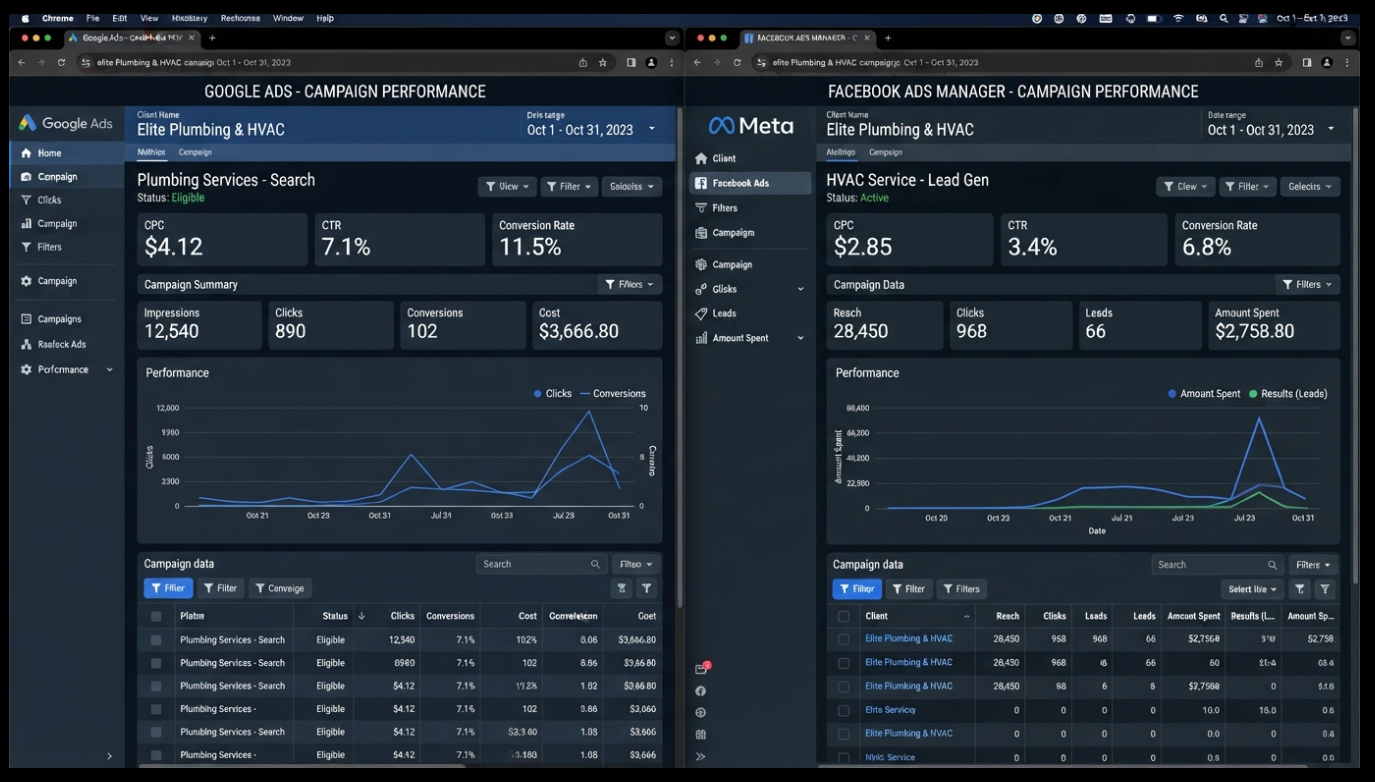
Generic averages don’t help you make a decision. Here’s how the two platforms actually perform across six specific local service verticals, based on aggregated campaign data from 2023–2024.
| Industry | Google Ads CPA | Facebook Ads CPA | Conversion Rate Gap | Recommended Primary Platform |
|---|---|---|---|---|
| Emergency Plumbing | $35–$65 | $80–$150 | 3.5x Google | Google Ads |
| HVAC (Repair + Install) | $45–$85 | $70–$130 | 2.8x Google | Google Ads |
| Dental (General + Cosmetic) | $50–$100 | $55–$95 | 1.4x Google | Split (Google for urgent, Facebook for cosmetic) |
| Personal Injury Legal | $70–$150 | $90–$200 | 2.2x Google | Google Ads |
| Roofing | $40–$80 | $60–$110 | 2.5x Google | Google Ads |
| Med Spa / Elective | $80–$160 | $40–$80 | 1.8x Facebook | Facebook Ads |
The pattern is unmistakable. For urgent, need-it-now services, Google Ads dominates. When someone’s pipe bursts at midnight, they don’t scroll Instagram looking for plumber recommendations — they search Google and call the first result.
The one clear exception is elective and lifestyle services. Med spas, cosmetic dentistry, and elective procedures perform better on Facebook because the customer journey starts with awareness, not urgency. Nobody wakes up with a Botox emergency. They see a before-and-after photo in their feed, get curious, and book a consultation three weeks later.
When Google Ads Wins (And the 2 Scenarios Where It Doesn’t)
Google Ads is the superior platform when your business meets at least two of these three criteria:
1. Your customers search for your service when they need it.
Emergency repairs, urgent medical care, legal consultations, and same-day services all generate high-intent search volume. Google Ads captures that intent at the exact moment of purchase readiness.
2. Your average job value exceeds $500.
The higher your customer lifetime value, the more you can afford to pay per click. A roofing company closing $12,000 jobs can comfortably absorb a $75 CPA. A coffee shop selling $5 lattes cannot.
3. Your service area is geographically defined.
Google Ads lets you target specific zip codes, cities, and radius-based areas with precision. For local service businesses operating within a 20–30 mile radius, this geographic targeting eliminates wasted spend on clicks from people you can’t serve.
The two scenarios where Google Ads underperforms:
First, when your service has no search volume. If you’ve invented a new category or offer something people don’t know to search for, there are no keywords to bid on. You can’t capture demand that doesn’t exist yet.
Second, when your market is so competitive that CPCs exceed your profit margin. In some metro areas, personal injury keywords run $50–$100 per click. If your average case value is under $5,000, the math breaks down and you’ll need a different acquisition channel.
When Facebook Ads Wins (And the 2 Scenarios Where It Doesn’t)
Facebook Ads is the superior platform when your business model aligns with demand generation rather than demand capture.
1. Your service is visual and aspirational.
Before-and-after photos of kitchen remodels, smile transformations, and landscaping projects stop the scroll on Facebook in a way that text-based search ads simply cannot. Visual proof drives emotional decisions, and emotional decisions drive elective purchases.
2. Your customer journey is long and research-heavy.
If your average sales cycle is 30–90 days — think home remodeling, financial planning, or high-end consulting — Facebook’s retargeting capabilities keep your brand in front of prospects throughout their decision-making process at a fraction of Google’s retargeting cost.
3. You need to build awareness in a new market.
Launching a new location, introducing a new service line, or entering a market where competitors haven’t yet established search dominance? Facebook’s lookalike audiences and interest-based targeting let you reach potential customers before they start searching.
The two scenarios where Facebook Ads underperforms:
First, when your audience is actively searching for a solution right now. Interrupting their Facebook scroll with a plumbing ad when their pipe isn’t leaking is wasted spend. They’ll scroll past, and you’ll pay for the impression anyway.
Second, when your targeting is too broad and your creative is generic. Facebook Ads rewards specificity — narrow audiences, compelling creative, and clear offers. The “boost post” approach that most small businesses default to generates likes and comments but almost never generates profitable leads.
The Attribution Trap — Why Your Facebook ROI Probably Looks Better Than It Is
This is the section that makes most agency reps uncomfortable, and it’s the single most important concept in the entire Google Ads vs Facebook Ads debate.
Facebook’s attribution model systematically overcredits its own platform. By default, Meta Ads Manager uses a 7-day click and 1-day view attribution window. That means if someone sees your Facebook ad on Monday, doesn’t click it, then searches your business name on Google on Thursday and fills out your contact form, Facebook claims credit for that lead.
Google Analytics, using last-click attribution, credits that same lead to organic search or branded Google Ads. Your Facebook dashboard says you generated 40 leads last month. Your CRM says 15 of those leads actually came from Google Search. The other 25 were view-through attributions — people who saw your ad but would have found you anyway.
I’ve audited dozens of accounts where Facebook’s reported CPA was $45 but the actual CRM-verified CPA was $95–$120. The gap is almost always attribution overlap. Facebook takes credit for leads that Google Search actually closed.
The fix is straightforward but requires discipline:
- Implement server-side tracking with a tool like HubSpot’s attribution reporting or Triple Whale’s multi-touch model
- Use UTM parameters on every Facebook ad URL and track conversions in your CRM, not in Meta Ads Manager
- Compare platform-reported CPAs against actual CRM-verified CPAs monthly
- Run holdout tests — pause Facebook Ads for two weeks and measure whether your total lead volume actually drops
If your total leads don’t decrease when you pause Facebook, you’re paying for attribution credit, not incremental customers. That’s the most expensive mistake in digital advertising, and it’s the reason so many small businesses feel like their Facebook Ads “work” but their bank account doesn’t reflect it.
Meta Ads Manager attribution settings documentation
If you’re currently spending on both platforms and can’t tell which one is actually generating your leads, stop increasing budgets until you solve the attribution problem. You might be doubling down on a channel that’s taking credit for work the other channel is doing. Fix the tracking first, then scale the winner.
Should You Run Google Ads and Facebook Ads Together?
The short answer is yes — but only if your total monthly budget exceeds $3,000 and you’ve already proven profitability on one platform first.
The most effective combination I’ve seen for local service businesses follows a specific sequence. Run Google Search Ads as your primary demand-capture engine. This is where the highest-intent, highest-converting leads come from. Fund this channel until your CPA stabilizes and your campaigns exit the learning phase.
Then layer Facebook Ads exclusively for retargeting. Target website visitors who clicked your Google Ads but didn’t convert, showed users who watched 50%+ of your video content, and customer list lookalikes. Facebook’s retargeting CPCs are typically 50–70% lower than its cold prospecting CPCs, and the conversion rates are 2–3x higher because these people already know your brand.
The budget split that works for most local service businesses: 70–80% to Google Ads, 20–30% to Facebook retargeting. Not 50/50. Not 60/40. The platform that captures existing demand should always receive the majority of your budget unless you’re in an elective/lifestyle vertical.
The businesses that get this wrong split their $2,000 budget evenly across both platforms, starve both campaigns of the data they need to optimize, and conclude that “paid ads don’t work.” The problem was never the platforms. It was the allocation.
how much to spend on Google Ads per month
The $3,000 Split-Test I Ran for a Plumbing Client (Real Results)
Numbers in a table are one thing. Here’s what this looks like in practice with real money and real consequences.
A plumbing company in a mid-size Texas metro came to me spending $1,500/month on Google Ads and $1,500/month on Facebook Ads. Their agency told them the 50/50 split was “diversifying their lead sources.” Their total monthly leads averaged 22, and their cost-per-acquisition was roughly $136.
I proposed a 90-day split test. Month one: maintain the 50/50 split as a baseline. Month two: shift to $2,500 Google / $500 Facebook retargeting only. Month three: hold the new allocation and measure.
Month 1 (Baseline — 50/50 split):
- Google Ads: 14 leads at $107 CPA
- Facebook Ads: 8 leads at $187 CPA
- Total: 22 leads at $136 blended CPA
- Facebook’s dashboard claimed 16 leads. CRM verified 8. The attribution gap was 50%.
Month 2 (Shifted — $2,500 Google / $500 Facebook retargeting):
- Google Ads: 26 leads at $96 CPA (more budget unlocked more keyword coverage)
- Facebook Retargeting: 6 leads at $83 CPA (retargeting only, no cold prospecting)
- Total: 32 leads at $93 blended CPA
Month 3 (Held steady):
- Google Ads: 31 leads at $80 CPA (algorithm fully optimized with more data)
- Facebook Retargeting: 7 leads at $71 CPA
- Total: 38 leads at $78 blended CPA
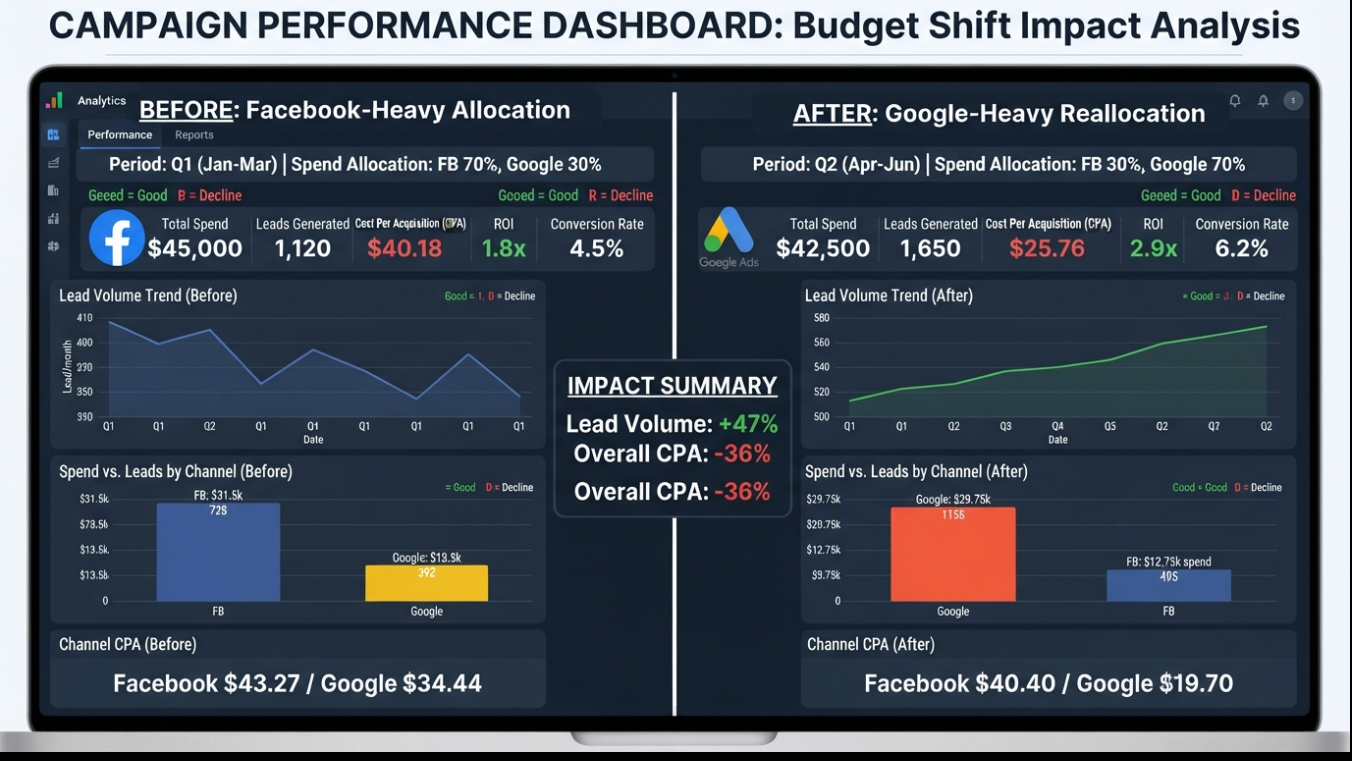
The result: 73% more leads at 43% lower CPA — same total budget. The only change was shifting money from cold Facebook prospecting to Google Search demand capture and using Facebook exclusively for retargeting warm traffic.
The agency lost the account. The plumber saved $18,000 in annual ad waste.
Frequently Asked Questions: Google Ads vs Facebook Ads
Which is cheaper Google Ads or Facebook Ads?
Facebook Ads is cheaper per click ($0.97 average CPC vs. $2.69 for Google Ads) and dramatically cheaper per thousand impressions ($7–$12 CPM vs. $20–$40 CPM). However, Google Ads is cheaper per qualified lead for local service businesses because search intent drives 2–4x higher conversion rates, offsetting the higher per-click cost entirely.
Should I use Google Ads or Facebook Ads for lead generation?
For local service businesses generating leads from people actively searching for your service, Google Ads outperforms Facebook Ads by 2–4x on conversion rate and 30–50% on cost-per-acquisition. Facebook Ads excels at generating demand among audiences who don’t yet know they need your service — ideal for elective procedures, new product launches, and brand-awareness campaigns.
Can I run Google Ads and Facebook Ads at the same time?
Yes, and the most effective approach for local service businesses is running Google Search Ads for demand capture while using Facebook Ads exclusively for retargeting website visitors who didn’t convert. This combination typically reduces blended CPA by 15–25% compared to running either platform alone, as long as your total budget exceeds $3,000 per month.
Do Facebook Ads actually work for local businesses?
Facebook Ads work for local businesses when targeting awareness and retargeting, but they underperform Google Ads for direct lead generation in urgent-need industries. A plumber advertising on Facebook reaches people scrolling their feed — most of whom don’t have a plumbing emergency right now. That same plumber on Google Ads reaches people actively typing “emergency plumber near me.” Intent matters more than reach.
Pick Your Platform and Go All In
The Google Ads vs Facebook Ads debate ends the moment you answer one question: do your customers search for your service when they need it, or do they need to be reminded that your service exists?
If they search — and for most local service businesses, they do — fund Google Ads first. Capture the demand that already exists. Prove your unit economics. Then layer Facebook retargeting to recapture the 95% who didn’t convert on their first visit.
If they don’t search — because your service is elective, visual, or entirely new to the market — start with Facebook Ads to build awareness and generate demand. Use compelling creative, narrow targeting, and a clear offer. Then add Google Ads once people start searching for your brand name.
Stop splitting your budget 50/50 across both platforms and hoping something sticks. Pick the channel that matches your customer’s buying behavior, fund it properly, and dominate it before you diversify. The businesses that win at paid advertising aren’t the ones on every platform — they’re the ones that are unbeatable on one.
If you’ve made it this far, you already understand the demand-capture vs. demand-gen distinction better than most agency reps who are actively pitching you a “full-funnel strategy” on both platforms. So here’s the real question: have you verified your Facebook attribution numbers against your actual CRM data yet?
If yes, you already know which platform deserves your budget. If no, that’s your assignment this week — before you approve another month of spend on a channel that might be taking credit for leads it didn’t actually generate. Bookmark this page, share it with whoever controls your marketing budget, and read our complete guide on whether Google Ads is worth it for your business to confirm the math before you commit.
