

How to Lower CPC in Google Ads: The 6-Lever Reduction Waterfall I Use to Cut Client Costs by 40–60%
I dropped a roofing client’s average CPC from $8.50 to $3.20 in 30 days without reducing their ad position or losing a single impression. The fix wasn’t lowering bids — that would have killed their visibility. The fix was a specific sequence of six levers that reduced the amount Google charged them per click while maintaining their competitive position in the auction. If your CPC feels too high, the answer is almost never “bid less.” The answer is making Google’s algorithm want to charge you less. Here’s the exact waterfall I use, ranked by dollar impact.
The $8.50-to-$3.20 CPC Drop — What Actually Moved the Needle
Before I walk through the framework, here’s the real account so you understand the context.
The roofing company was spending $4,200/month on Google Search Ads across 35 keywords. Their average CPC was $8.50, which meant their budget bought roughly 494 clicks per month. At a 4.2% conversion rate, that generated about 21 leads at a cost of $200 per lead. Not terrible, but the owner knew competitors were paying $4–$5 per click for the same keywords and he wanted to understand why he was paying nearly double.
The diagnostic revealed four compounding problems:
- Quality Score averaged 4/10 across all keywords (triggering a 25–40% CPC surcharge)
- 60% of keywords were on broad match, entering irrelevant high-competition auctions
- Only 12 negative keywords existed in the entire account after 8 months of running
- Ad groups contained 20–30 loosely related keywords served by generic ad copy
After applying the six levers below over 30 days:
- Average CPC dropped to $3.20 (62% reduction)
- Monthly clicks increased to 1,312 (165% increase on the same budget)
- Leads increased to 48 (128% increase)
- CPA dropped from $200 to $87 (56% reduction)
The budget never changed. The market never changed. The settings did.
The CPC Reduction Waterfall — 6 Levers Ranked by Dollar Impact
Most “how to lower CPC” articles give you an unordered list of 10–15 tips and tell you to try them all. That’s not a strategy — it’s a scavenger hunt.
Here’s the prioritized waterfall I use with every client. Execute these in order. Each lever builds on the previous one, and the dollar impact decreases as you move down the list.
| Lever | Action | Estimated CPC Reduction | Time to Impact |
|---|---|---|---|
| #1 | Fix Quality Score | 25–50% | 2–4 weeks |
| #2 | Kill broad match, restructure match types | 15–25% | 1–2 weeks |
| #3 | Deploy negative keywords aggressively | 10–20% | 1–2 weeks |
| #4 | Lower bids on low-converting segments | 5–15% | Immediate |
| #5 | Shift budget to long-tail exact match | 10–20% | 2–3 weeks |
| #6 | Tighten ad group relevance | 5–10% | 2–4 weeks |
Cumulative potential reduction: 40–60% when all six levers are applied. The key is sequencing. Fixing Quality Score first creates a compounding effect that amplifies every subsequent lever. Skipping to lever #4 (bid reduction) without addressing levers #1–#3 is the most common mistake I see — you’ll lower your CPC but also lose your ad position and impression volume.
Lever #1 — Fix Your Quality Score (The 50% CPC Discount)
This is the single most powerful CPC reduction lever, and it’s the one most advertisers understand the least.
Here’s the actual math behind how Quality Score affects your CPC. Google’s ad auction formula determines your actual cost per click using this simplified equation:
Actual CPC = (Ad Rank of the advertiser below you ÷ Your Quality Score) + $0.01
This means your Quality Score is literally in the denominator of the pricing equation. A higher Quality Score mathematically reduces your CPC. The impact is dramatic:
| Quality Score | CPC Impact vs. Average |
|---|---|
| 10/10 | ~50% discount |
| 8/10 | ~25% discount |
| 7/10 | ~15% discount |
| 5/10 | Baseline (no discount, no surcharge) |
| 4/10 | ~25% surcharge |
| 3/10 | ~40% surcharge |
| 1–2/10 | ~50–80% surcharge |
If your Quality Score is 4/10 and your competitor’s is 8/10, you’re paying roughly 60% more per click than they are for the exact same ad position. That’s not a competitive disadvantage — it’s a tax on poor relevance.
The three components to fix, in order of weight:
- Expected CTR (~50% of Quality Score): Rewrite headlines to include the exact keyword the user searched. Pin your primary keyword into headline position 1 of your responsive search ads. Add ad extensions to increase real estate and clickability.
- Ad Relevance (~25%): Ensure each ad group contains tightly themed keywords that match the ad copy. If your ad group targets “roof repair,” “roof replacement,” and “gutter installation” with a single generic ad, your relevance score will tank.
- Landing Page Experience (~25%): Your landing page must load in under 3 seconds, match the ad’s promise, and contain a clear conversion path. Sending paid traffic to your homepage is a Quality Score death sentence.
Google Ads Quality Score and CPC relationship documentation
Lever #2 — Kill Broad Match and Restructure Match Types
Broad match is Google’s default keyword match type, and it’s the single biggest driver of inflated CPCs in small business accounts. Here’s why.
When you set a keyword to broad match, Google enters your ad into auctions for any search query it deems “related” to your keyword — including synonyms, misspellings, tangentially related topics, and queries with completely different intent. A broad match keyword like “roof repair” might trigger your ad for “how to repair a roof yourself,” “roof repair cost calculator,” and “roofing jobs near me.” You’re paying $8.50 per click for searches that will never convert.
The fix is straightforward:
- Navigate to Keywords → Search Terms and review the last 90 days of actual queries that triggered your ads
- Identify every query that is irrelevant to your commercial offering
- Switch your high-spend keywords from broad match to phrase match (using quotation marks: “roof repair”)
- Reserve exact match (using brackets: [emergency roof repair near me]) for your highest-converting, highest-intent keywords
The CPC impact: Phrase match keywords typically cost 15–25% less than broad match because you’re no longer entering irrelevant high-competition auctions. Exact match keywords often cost 20–30% less because the relevance signal to Google is stronger, which improves your Quality Score (see Lever #1).
My roofing client’s broad match keywords were averaging $9.80 CPC. After switching to phrase and exact match, the same keywords averaged $6.40 — a 35% reduction from match type restructuring alone.
Lever #3 — Deploy Negative Keywords Aggressively
Negative keywords are the most underused CPC reduction tool in small business accounts. Most accounts I audit have fewer than 20 negative keywords after months of running. The accounts that consistently achieve below-average CPCs have 200–500+ negative keywords actively filtering out waste.
Here’s the specific process I follow:
Week 1: Pull your search terms report for the last 90 days. Sort by impressions (descending). Add every irrelevant query as a negative keyword. Common categories for local service businesses: “DIY,” “how to,” “jobs,” “salary,” “free,” “cheap,” “training,” “course,” “YouTube,” and competitor brand names you don’t want to bid on.
Week 2: Add negative keyword lists at the account level for universal exclusions. These apply to all campaigns automatically and prevent you from paying for the same irrelevant queries across multiple ad groups.
Ongoing: Review your search terms report weekly for the first month, then biweekly. Every irrelevant impression that you don’t block is inflating your average CPC by dragging down your CTR and Quality Score.
The CPC impact: Aggressive negative keyword deployment typically reduces CPC by 10–20% within two weeks. The mechanism is indirect but powerful — by eliminating irrelevant impressions, your CTR increases, your Quality Score improves, and your actual CPC drops as a result of the Quality Score discount.
Lever #4 — Lower Bids on Low-Converting Segments
Now we get to the lever most articles put first — bid reduction. I put it fourth because lowering bids without fixing levers #1–#3 is the equivalent of treating a symptom while ignoring the disease.
But once your Quality Score, match types, and negative keywords are optimized, strategic bid reduction on underperforming segments can squeeze out another 5–15% in CPC savings.
The segments to audit:
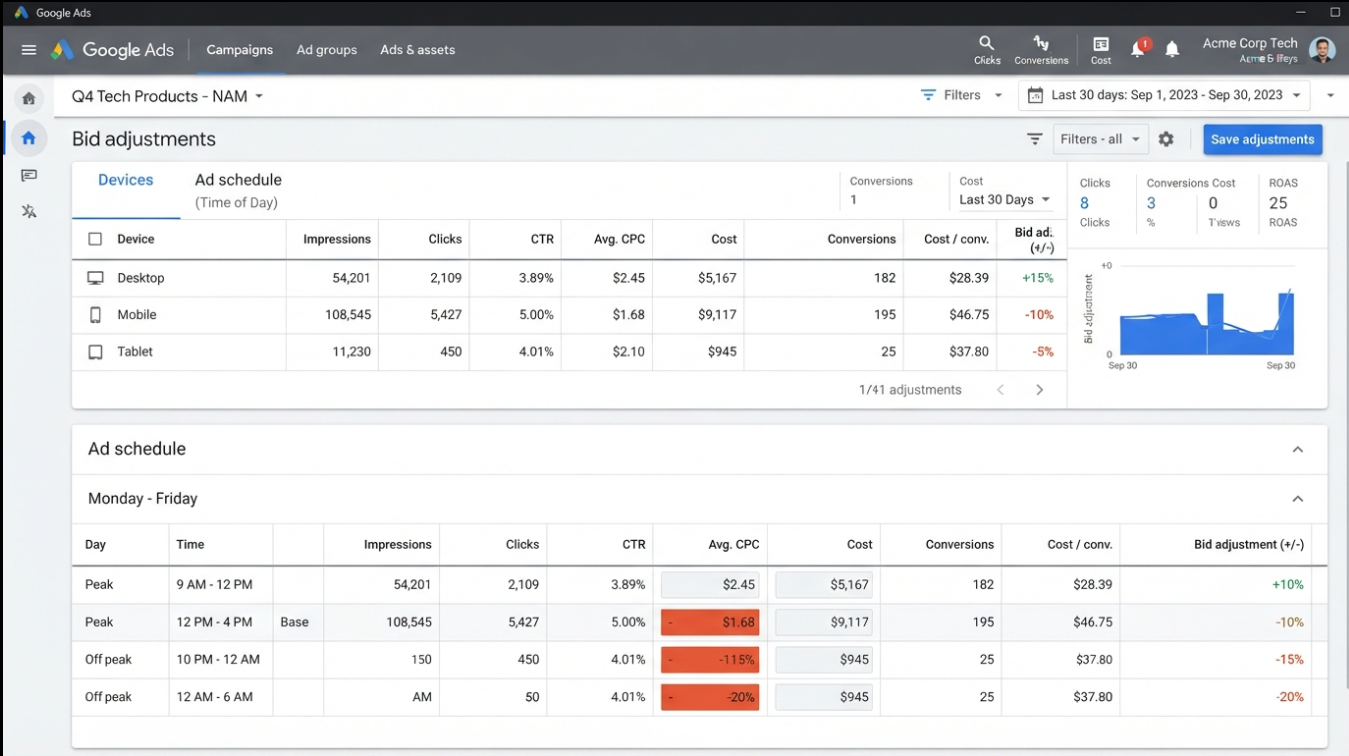
- Device: If mobile CPC is $7 but mobile conversion rate is 1%, while desktop CPC is $5 with a 6% conversion rate, apply a -20% bid adjustment on mobile. You’ll pay less for clicks that aren’t converting anyway.
- Time of day: If your CPC spikes 30% between 8–10 PM but conversions drop to zero during those hours, set a bid adjustment of -30% or exclude those hours entirely.
- Geography: If a specific zip code or city within your targeting radius has a 2x higher CPC but no conversions, exclude it or apply a negative bid adjustment.
- Audience: If your “in-market” audience segment has a higher CPC but lower conversion rate than your non-audience traffic, reduce the audience bid modifier.
The critical rule: Never lower bids across the board. Lower bids only on segments where the data clearly shows poor return. Blanket bid reductions will drop your ad position, reduce impressions, and ultimately increase your CPA even as your CPC decreases.
If your CPC is still above $5 after applying the first four levers, the issue may be deeper than settings — it may be your keyword selection or competitive landscape. At that point, it’s worth reviewing how to improve your Google Ads CTR to determine whether your ad relevance is fundamentally misaligned with your target market.
Lever #5 — Shift Budget to Long-Tail and Exact Match Keywords
Short, generic keywords like “roofing” and “roof repair” carry the highest CPCs because they attract the most competition. Every roofing company in your market is bidding on those terms, driving the auction price up.
Long-tail keywords like “emergency roof leak repair [city name]” and “storm damage roof inspection near me” carry significantly lower CPCs because fewer competitors bid on them — even though the searchers typing those queries are often further along in the buying cycle and more likely to convert.
The budget shift strategy:
- Identify your top 10 highest-CPC keywords that are consuming the majority of your budget
- For each one, generate 3–5 long-tail variants that include geographic modifiers, urgency signals, or specific service details
- Add the long-tail variants as exact match keywords with bids 20–30% lower than the parent keyword
- Gradually shift budget from the high-CPC generic terms to the lower-CPC long-tail terms over 2–3 weeks
- Monitor conversion volume to ensure the long-tail keywords are generating leads at a comparable rate
The CPC impact: Long-tail exact match keywords typically cost 20–40% less than their generic counterparts while converting at equal or higher rates. The trade-off is lower search volume — you’ll get fewer impressions — but the impressions you do get will be more qualified and cheaper.
Lever #6 — Improve Ad Relevance With Tighter Ad Groups
This is the slowest lever but the one that creates the most durable CPC reduction over time.
Most small business accounts have 3–5 ad groups containing 20–40 keywords each, all served by 1–2 generic responsive search ads. This structure guarantees mediocre ad relevance because a single ad cannot be highly relevant to 30 different keywords simultaneously.
The fix: Break your largest ad groups into smaller, tightly themed groups of 5–10 keywords each. Each ad group should have ad copy that specifically addresses the search intent of those keywords.
Before (single bloated ad group):
- Ad Group: “Roofing Services”
- Keywords: roof repair, roof replacement, roof inspection, gutter cleaning, siding installation, emergency roofing, commercial roofing, residential roofing
- Ad: Generic “We Do All Roofing Services” headline
After (tightly themed ad groups):
- Ad Group: “Emergency Roof Repair” → Keywords: emergency roof repair, roof leak repair, storm damage roof → Ad: “24/7 Emergency Roof Repair — On-Site in 60 Minutes”
- Ad Group: “Roof Replacement” → Keywords: roof replacement cost, new roof installation, roof replacement near me → Ad: “Complete Roof Replacement — Free Estimate & 10-Year Warranty”
- Ad Group: “Roof Inspection” → Keywords: roof inspection, roof inspection cost, certified roof inspector → Ad: “Certified Roof Inspection — Detailed Report in 24 Hours”
The CPC impact: Tighter ad groups improve ad relevance scores by 1–3 points on the Quality Score scale, which translates to a 5–15% CPC reduction through the Quality Score discount mechanism. The effect compounds over time as Google’s algorithm rewards consistently relevant ads with lower auction costs.
The “Lower CPC Trap” — When Cheaper Clicks Cost You More Money
Here’s the thing most CPC optimization articles won’t tell you: a lower CPC is not always better.
I’ve seen advertisers obsessively reduce their CPC from $6 to $2 by switching to low-competition, low-intent keywords — only to watch their conversion rate drop from 8% to 0.5%. Their CPC looked fantastic on the dashboard. Their cost-per-acquisition tripled.
The math that matters:
- Scenario A: $6 CPC × 5% conversion rate = $120 CPA
- Scenario B: $2 CPC × 0.8% conversion rate = $250 CPA
Scenario B has a 67% lower CPC and a 108% higher CPA. The advertiser in Scenario B is “winning” the CPC metric and losing their business.
The rule I follow: Never optimize for CPC in isolation. Always evaluate CPC changes alongside conversion rate and cost-per-acquisition. If your CPC drops but your CPA rises, you’ve made your campaign worse, not better. The goal is profitable customer acquisition, not cheap clicks.
When lower CPC is genuinely good: When it comes from Quality Score improvements, negative keyword filtering, or match type restructuring — because these methods reduce CPC while maintaining or improving click quality.
When lower CPC is a trap: When it comes from bidding on low-intent keywords, reducing bids below competitive thresholds, or targeting broad audiences with weak commercial signals.
Frequently Asked Questions About Lowering Google Ads CPC
Why is my CPC so high on Google Ads?
High CPC on Google Ads is usually caused by one of three factors: a Quality Score below 5/10 (which triggers a 25–40% CPC surcharge), broad match keywords entering irrelevant high-competition auctions, or aggressive competitor bidding in your market. Check your Quality Score column first — it’s the single biggest lever you control and the fastest path to meaningful cost reduction.
How to lower CPC without losing impressions?
The safest way to lower CPC without losing impressions is improving your Quality Score rather than reducing bids. A Quality Score increase from 5 to 8 can reduce your actual CPC by 25–35% while maintaining or even improving your ad position. Focus on expected CTR, ad relevance, and landing page experience before touching your bid amounts.
How does Quality Score affect CPC in Google Ads?
Quality Score directly impacts your actual CPC through a discount and surcharge mechanism. A Quality Score of 10/10 can reduce your CPC by up to 50% compared to the auction minimum. A Quality Score of 3/10 can increase your CPC by 25–40%. The relationship is inverse and mathematical: higher Quality Score equals lower cost per click at every auction.
What is a good CPC for Google Ads?
A good CPC for Google Ads is one that allows you to acquire customers profitably — typically 20–30% of your customer lifetime value. Cross-industry averages range from $1–$2 for e-commerce to $6–$14 for legal and home services. Don’t chase a specific CPC number in isolation; chase a cost-per-acquisition that works for your business model and profit margins.
Calculate Your Savings and Execute the Waterfall This Week
Your CPC is not a fixed cost dictated by your industry. It’s a variable output determined by your Quality Score, match type strategy, negative keyword hygiene, bid segmentation, keyword selection, and ad group structure. You control all six levers, and you now have the exact sequence to pull them in.
Here’s your action plan for this week:
- Open your Google Ads dashboard and add the Quality Score, Expected CTR, Ad Relevance, and Landing Page Experience columns to your keyword view
- Identify every keyword with a Quality Score below 5/10 — these are your highest-priority fixes
- Switch your top 10 broad match keywords to phrase match
- Spend 30 minutes mining your search terms report for negative keywords
- Apply bid adjustments to your worst-performing device and time-of-day segments
If you execute just the first three levers this week, you should see a measurable CPC reduction within 14 days. The remaining three levers will compound the savings over the following 30–60 days.
If you’ve made it this far, you now have a more systematic CPC reduction plan than most agency account managers who are charging $1,500/month to manage your campaigns. So here’s the real question: what’s your current average Quality Score across your top 20 keywords?
If it’s above 7, your CPC is probably already competitive and you should focus on conversion rate optimization instead. If it’s below 5, you’re overpaying by 25–40% on every single click — and the waterfall above will fix that within 30 days. Bookmark this page, share it with whoever manages your ad spend, and read our guide on how much to spend on Google Ads per month to make sure your newly reduced CPC is translating into a budget that actually scales.
