
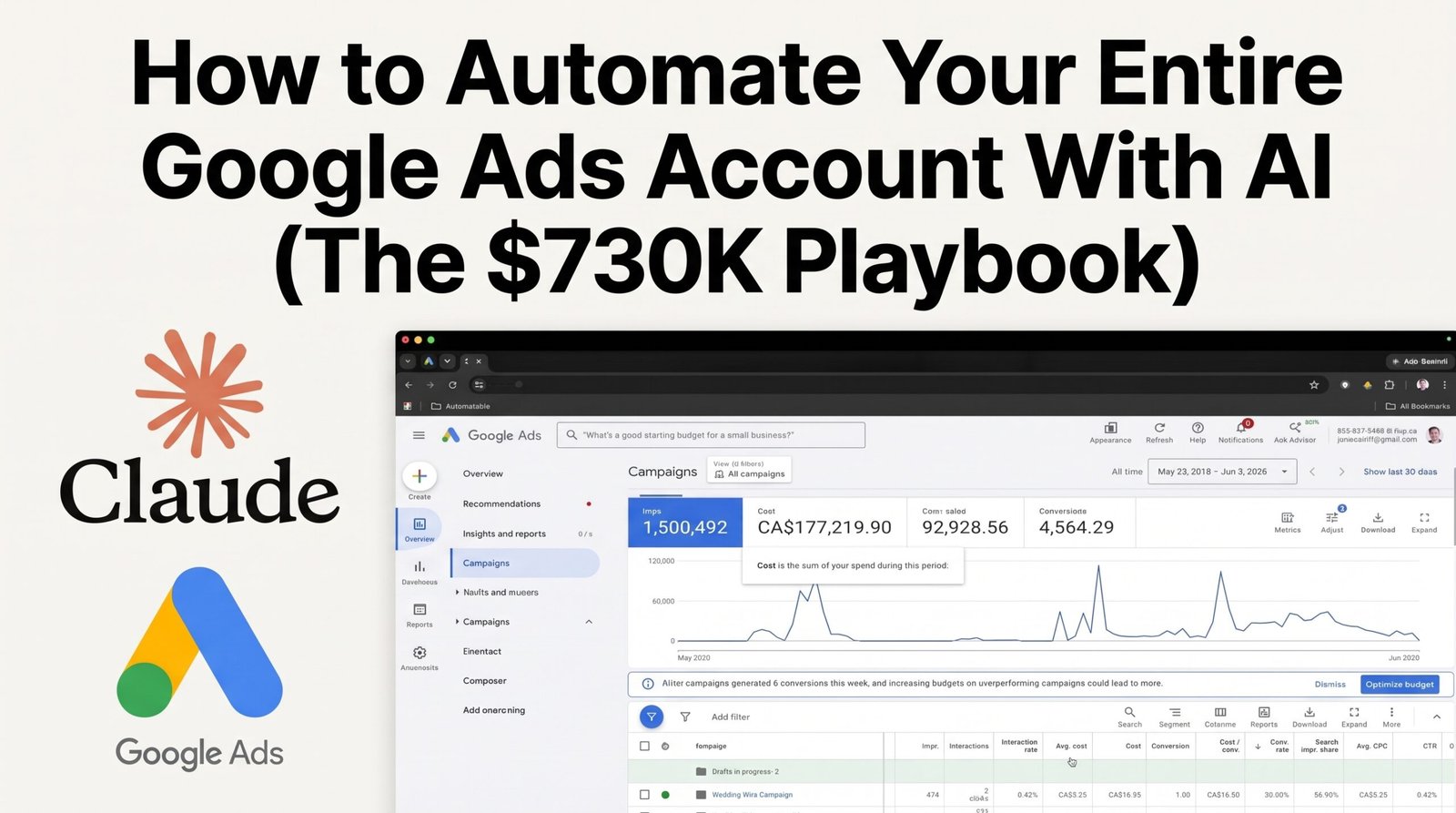
Automate Google Ads With AI: The $730K SKAG Playbook
How to Automate Your Entire Google Ads Account With AI (The $730K Playbook)

How to Automate Your Entire Google Ads Account With AI (The $730K Playbook). You can automate your full Google Ads workflow — campaigns, ad copy, landing pages, negative keyword audits, and ROAS tracking — by connecting Claude Code to the Google Ads API. The setup takes roughly five minutes. After that, tasks that used to eat 16 hours of manual work compress into a two-minute prompt. This playbook walks through the exact framework that generated $730,000 in tracked revenue at a 20% conversion rate, and it starts with the one thing most advertisers get dead wrong.
Why Most Google Ads Accounts Bleed Money
Your Google Ads representative’s bonus is tied to your ad spend, not your profit. That single fact explains why the “Recommendations” tab inside your account pushes you to broaden targeting, increase budgets, and enable Performance Max — moves that inflate your costs while padding Google’s revenue.
The three money traps to disable today:
- Optimization Score suggestions. These are algorithmically generated upsells, not strategic advice. Accepting them wholesale typically increases spend 15–30% without proportional revenue gains.
- Account manager calls. The person on the phone is a sales rep with a quota. Their incentive structure is misaligned with your bottom line by design.
- Vanity metric dashboards. Click-through rate and impression share look impressive in reports. They do not deposit money in your bank account. The only metric that matters is return on ad spend — actual revenue minus actual cost.
If you are generating $58,000/month across multiple channels and cannot trace which paying customers originated from Google Ads versus SEO versus referral, you are flying blind. The fix is not more data. It is the right data, connected end-to-end from click to invoice.
The Single Keyword Ad Group Framework That Drove $730K
The architecture behind the $730K result is deceptively simple: one search term per ad group, one ad tailored to that term, one landing page built for that exact query. This is the Single Keyword Ad Group (SKAG) model, and it outperforms the standard “dump 50 keywords into one ad group” approach for one reason — relevance.
When someone searches “emergency plumber Mississauga,” they should not land on a page about galvanized pipe replacement. Yet that is exactly what happens when advertisers use generic ad groups. The search-to-ad-to-landing-page chain breaks, quality scores drop, and cost per click rises.
The SKAG alignment chain:
- Search query: “emergency plumber Mississauga”
- Ad headline (pinned): “Emergency Plumber Mississauga”
- Landing page H1: “24/7 Emergency Plumbing in Mississauga”
- Form confirmation email: “Your Mississauga Emergency Plumber Is On the Way”
Every link in that chain reinforces the same intent. Google rewards this with higher quality scores, which directly lowers your cost per click. Over seven years and $177,000 in tracked spend, this framework produced conversion rates in the 99th percentile.
The scaling trick is a city-service matrix. Build separate SKAGs for every combination: emergency plumbing Toronto, emergency plumbing Brampton, blocked drain Scarborough, blocked drain Markham. Not every suburb will have enough search volume to justify the effort — validate each cell in Keyword Planner before building.
Finding Winning Keywords Without Wasting Budget on Junk Traffic
AI tools will confidently hand you keyword lists full of zero-volume terms and irrelevant queries. Do not trust them blindly. The only reliable source is Google’s own Keyword Planner, which shows actual monthly search volume, competition levels, and cost-per-click estimates.
The match type hierarchy that saves money:
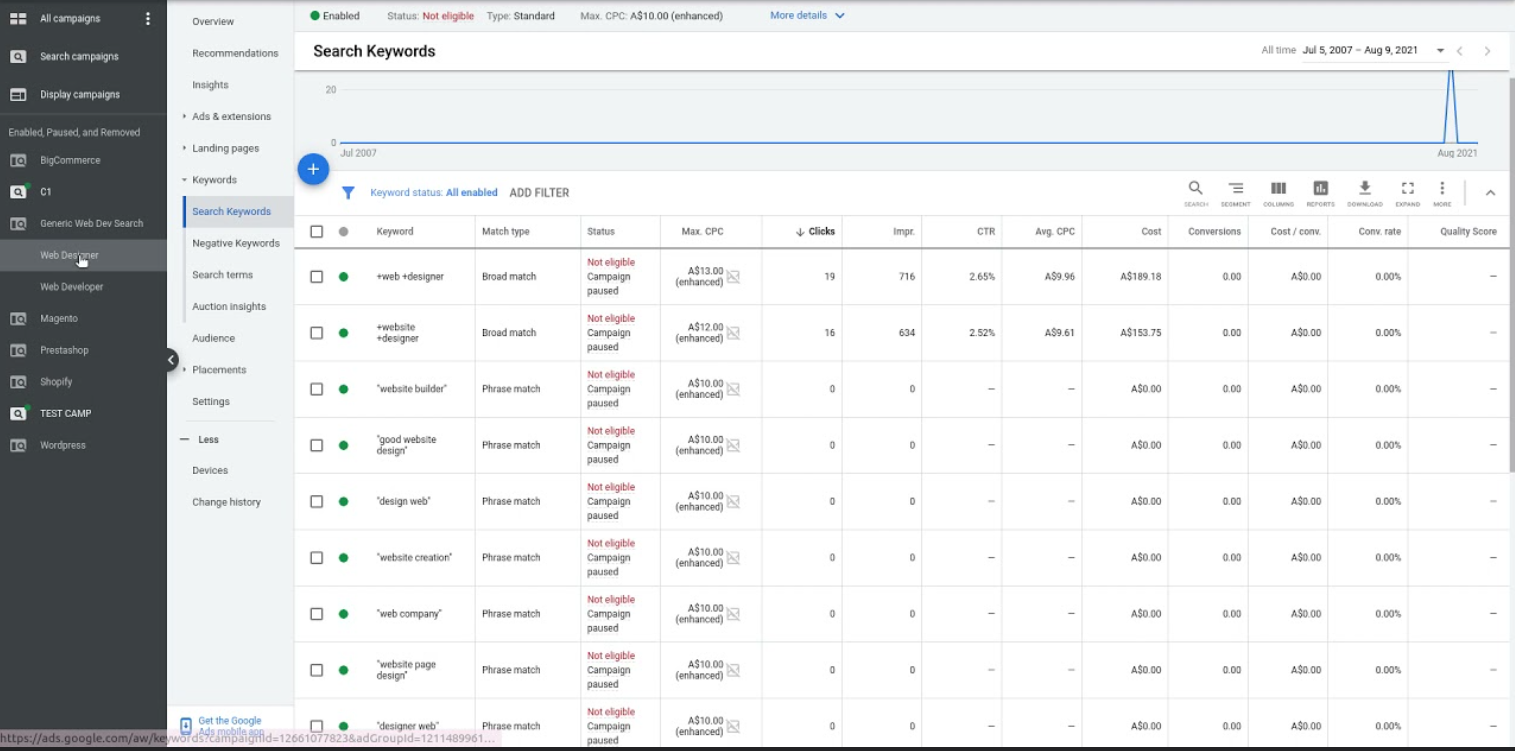
- Broad match is a budget incinerator. Google’s machine learning pulls in semantically adjacent garbage — “plumber salary Toronto” and “DIY clogged drain” when you wanted “emergency plumber Toronto.” Avoid it.
- Phrase match is the winner. The user’s search must contain your exact phrase, but can include words before or after it. This captures the thousand different ways people express the same intent without letting in irrelevant noise.
- Exact match is too restrictive for scaling. Use it only for your highest-value, highest-volume terms.
Filter by geography immediately. Keyword Planner defaults to your entire country. If you service clients in Toronto, you do not want to pay for clicks from Vancouver. Set your location radius to roughly 50 kilometers around your downtown core, and switch the targeting mode from “Presence or Interest” to “Presence” only — otherwise Google will show your ads to people merely curious about your city from halfway around the world.
Automating Campaigns, Ad Copy, and Split Testing in Minutes
Here is where the manual grind dies. Creating 200 ad variations used to take 8–16 hours of focused work — writing headlines, descriptions, sitelinks, callouts, and structured snippets for each SKAG. With Claude Code connected to the Google Ads API, the same batch runs in under two minutes.
The technical stack (all free except Claude Pro):
- VS Code — the workspace where Claude Code operates as an extension.
- Google Ads Manager Account — links to your existing ad account via the API.
- Google Cloud Console — provides OAuth credentials and enables the Google Ads API (2,880 requests/day on the free tier).
- Claude Code — reads your campaign blueprint files and executes the build.
The critical detail most tutorials skip: pin your root keyword in headline position one. Google’s responsive search ads will rotate your 15 headlines automatically, but if position one shows “Same Day Service” instead of “Emergency Plumber Toronto,” users scroll past because the ad does not mirror their search. Pin the keyword. Let Google test the value propositions in positions two and three.
Maximize digital real estate by filling every extension — sitelinks, callouts, structured snippets, images. More screen space means higher click-through rates, which feeds back into quality score and cheaper clicks.
Landing Pages That Convert Search Traffic at 20%
The landing page that produced a 20% conversion rate was not beautiful. It was specific. The headline matched the search query exactly, the form sat above the fold, and the page loaded in under two seconds.
The five non-negotiable elements:
- Query-matched headline. If the ad says “Emergency Plumber Toronto,” the page says “Emergency Plumber Toronto.” Not “Toronto Plumbing Services.” Exact match.
- Video testimonials. Social proof is the single highest-leverage conversion driver. A 30-second clip of a real customer outperforms every stock photo on the internet.
- Founder video. People buy from people they like. A 60-second introduction where you look directly at the camera and explain why they should choose you over the competitor down the street builds trust faster than any copy block.
- Above-the-fold form. Every additional click between the user and your form cuts conversions. Put the form on the landing page itself, not a “Contact Us” link.
- Speed to lead. Call every form submission within 60 seconds. The average business takes 48 hours. Responding in under a minute can quadruple your close rate without spending an extra dollar on ads.
Claude Code builds these pages using Next.js, and you can feed it a Dribbble design mockup to clone the visual style. The output is static HTML you deploy through GitHub and Vercel — both free — in under five minutes.
The ROAS Tracking Pipeline Most Advertisers Skip
Clicks do not make you money. Leads do not make you money. Paying customers make you money. Yet most advertisers optimize for conversions (form fills) without ever connecting those conversions to actual revenue.
The five-step ROAS pipeline:
- URL parameters. Append
?keyword={keyword}&campaign={campaign}&gclid={gclid}to your final URLs. This passes search context into your landing page. - Hidden form fields. Your form captures name, email, and phone — but also silently captures the keyword, campaign, and click ID from the URL parameters.
- CRM logging. When the form submits, your CRM records the lead source down to the exact keyword that triggered the click.
- Revenue attribution. When that lead pays an invoice, a workflow updates the CRM with the actual dollar amount.
- Offline conversion upload. Export the paying customer data as a CSV and upload it to Google Ads. Now Google’s algorithm knows which keywords produce revenue, not just leads, and optimizes your automated bidding strategy accordingly.
Without step five, Google assumes every lead is worth the same amount. A $500 client and a $15,000 client look identical to the algorithm. Feed it real revenue data and it starts finding more $15,000 clients.
How Much Does Google Ads Management Actually Cost?
The Google Ads management cost landscape breaks into three tiers, and most small businesses are overpaying by default.
| Model | Monthly Cost | Best For | Hidden Risk |
|---|---|---|---|
| PPC Agency (flat fee) | $2,000–$5,000 | Budgets over $20K/mo | Incentive to maintain complexity, not simplify |
| PPC Agency (% of spend) | 15–20% of ad spend | Enterprise accounts | Agency profits more when you spend more |
| AI Automation (Claude Code + API) | $20–$100 | Budgets under $20K/mo | Requires initial 2–4 hour setup |
For a business spending $5,000/month on ads, a 20% agency fee adds $1,000/month — $12,000/year — for work that Claude Code now handles in minutes: campaign creation, ad copy generation, negative keyword audits, and bid optimization. The AI automation software approach does not replace strategic thinking. It replaces the repetitive execution that agencies bill you thousands for.
The honest caveat: If you need someone to fundamentally rethink your offer, positioning, or funnel architecture, hire a strategist. If you need someone to build 200 SKAGs and rotate ad variants, automate it.
Cutting Wasted Spend With AI Negative Keyword Audits
Even with a perfect SKAG structure, junk search terms leak into your account. The most damaging example I found in a live audit: the keyword “DJ hiring” was burning budget because I assumed people searching it wanted to hire a DJ. Claude Code cross-referenced the term and discovered it is overwhelmingly used by job seekers on Indeed and ZipRecruiter. Zero conversion potential. Thousands of dollars wasted.
The two-layer negative keyword system:
- Universal list. Apply a pre-built block of negatives across all campaigns: “course,” “salary,” “DIY,” “free,” “apprenticeship,” “definition,” “coupon,” “training.” These never convert for service businesses.
- Search term mining. Run a weekly Claude Code audit that scans your actual search terms report, flags queries with zero conversions and high spend, and pushes them to your negative list automatically.
The audit that caught the “DJ hiring” leak took four seconds. I would never have found it manually.
Google Ads Masterclass (2026) | Complete Google Ads Training Course
Retargeting Warm Traffic Without Burning Budget on Display Junk
Cold traffic converts at a fraction of the rate of warm traffic. Someone who has already visited your landing page, read your headline, and almost filled out your form is exponentially more likely to convert on a second exposure.
Set up a Google Tag on your landing pages through Claude Code, then create a remarketing audience of all past visitors. The highest-performing retargeting format is Remarketing Lists for Search Ads (RLSA) — your search ads reappear for people who have already been to your site, with higher bids justified by higher conversion rates.
Display remarketing is a gamble. I have seen it work occasionally for warm audiences, but the click quality is inconsistent. Never run display ads to cold traffic. The accidental clicks and bot impressions will drain your budget faster than you can audit them.
Frequently Asked Questions
How much does it cost to automate Google Ads with AI?
The core stack — Claude Code, VS Code, Google Ads API, GitHub, and Vercel — costs between $20 and $100 per month depending on your Claude plan. This replaces Google Ads automation software and agency management fees that typically run $2,000–$5,000 per month. The initial setup takes approximately two to four hours.
What is the best bidding strategy for small businesses?
Start with Maximize Conversions to build a data foundation. Once you hit 30+ conversions per month, switch to Target CPA. When your CRM is feeding actual revenue data back into Google Ads, graduate to Target ROAS — the only automated bidding strategy that optimizes for profit rather than form fills.
How long until automated Google Ads show results?
Expect a 2–4 week learning period while Google’s algorithm calibrates to your SKAG structure and conversion data. Meaningful ROAS improvements typically appear within 60–90 days after implementing the full pipeline: SKAGs, negative keyword audits, landing page optimization, and offline conversion uploads.
Your 30-Day Automation Rollout Plan
Week 1: Connect Claude Code to the Google Ads API. Build your universal negative keyword list. Run your first account audit.
Week 2: Export your keyword research from Keyword Planner. Generate your first batch of SKAG campaigns and ad variations through Claude Code.
Week 3: Build and deploy query-matched landing pages via Next.js and Vercel. Install the Google Tag for remarketing.
Week 4: Set up the ROAS tracking pipeline (URL parameters → hidden fields → CRM → offline upload). Switch bidding to Target CPA once conversion data accumulates.
If you have made it this far, you already know more about Google Ads automation than 90% of the advertisers competing against you for the same keywords. The question is whether you will act on it.
Bookmark this page. Share it with the one person on your team who actually manages the ad account. And if you want to stop paying an agency to do what a $20/month AI tool handles in minutes, start with Week 1 today.
AUTHOR BIO: Jono, founder of two seven-figure businesses and Google Ads practitioner with $730K+ in tracked ad revenue and 20% conversion rates across service-based campaigns.
