
Google Ads for Local Services 2026: 5-Step Profit Framework
The 5-Step Google Ads Strategy Local Service Businesses Need in 2026 (Before You Burn Another Dollar)

The most profitable Google Ads strategy for local service businesses in 2026 starts with tightly structured search campaigns, presence-only location targeting, and ad copy that deliberately repels unqualified clicks — not Performance Max. With plumber and electrician CPCs now exceeding $50 per click, a misconfigured campaign can torch a $2,000 monthly budget in under 72 hours while generating zero booked jobs. The five steps below are the exact framework we use to cut wasted spend and drive down cost per acquisition for service businesses running Google Ads ROI campaigns on tight budgets.
The Two Budget Killers Every Local Service Business Faces
Local service businesses fight a two-front war on Google Ads that most generic marketing guides never address.
Killer #1: Micro-budgets. Most plumbers, electricians, HVAC companies, and IT service providers are working with $1,000–$3,000 monthly ad budgets. That’s not a criticism — it’s a reality.
Killer #2: Brutal CPCs. Emergency service keywords like “emergency plumber near me” or “24-hour electrician” routinely command $40–$65+ per click in competitive metros.
Do the math. At $50 per click, a $2,000 budget buys you 40 clicks. If your landing page converts at 5%, that’s two leads. Two leads for two thousand dollars.
That’s the scenario that makes business owners quit Google Ads entirely. But the problem isn’t the platform. The problem is campaign architecture. The five steps below fix the architecture.
Step 1: Start With Search — Ignore the Performance Max Hype
Even in 2026, with Google aggressively pushing Performance Max and Demand Gen campaigns at every turn, your foundation must be search.
Here’s why. Search campaigns give you granular control over three things that directly determine whether you survive those $50 CPCs: keyword match types, bid ceilings, and negative keyword lists. Performance Max gives you almost none of that.
The practical setup: Break your services into separate ad groups. If you’re an HVAC company running both “AC repair” and “furnace installation,” those are two ad groups with two distinct ad copies pointing to two distinct landing pages.
This isn’t optional organization. It’s the difference between a user searching “furnace replacement cost” and seeing a generic “We Do HVAC” ad versus seeing “Furnace Replacement — Same-Day Install, Prices From $2,800.” The second ad wins the click. The first wastes it.
Key takeaway: Build your search foundation first. Only layer Performance Max after you’ve accumulated 50+ conversions per month and understand exactly which keywords drive revenue.
Step 2: Fix the Location & Keyword Settings That Silently Drain Budgets
This is where most local service businesses lose money without realizing it — and the fix takes about four minutes inside your Google Ads dashboard.
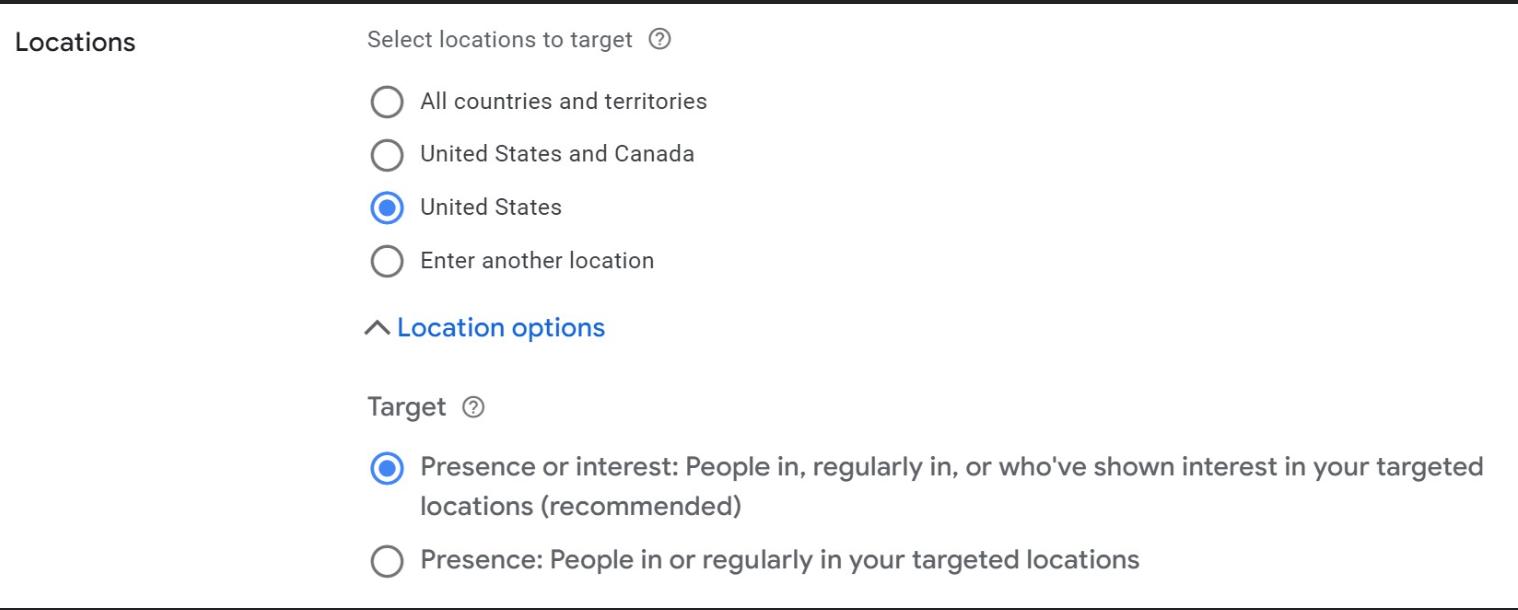
The location targeting trap. When you set your target zip codes or cities, Google defaults to “Presence or Interest.” That means someone in another state who searched “plumber in [your city]” can trigger your ad. You’re paying $50 for a click from someone 800 miles away.
The fix: Go to Campaign Settings → Locations → Location Options → Select “Presence: People in or regularly in your targeted locations.” This single toggle eliminates out-of-area waste immediately.
The keyword targeting trap. Exact match no longer means exact. Google now matches the meaning of your keywords, including close variants. A search for “fix my sink” can trigger your “plumber near me” exact match keyword.
The fix layer:
- Build account-level negative keyword lists first. Add: free, DIY, how to, download, images, reviews, salary, jobs, cheap, discount.
- Use broad match only with 4+ word phrases (e.g., “emergency water heater repair cost”) — never 1–2 word broad terms.
- Pair broad match with exact match. Broad discovers new queries; exact locks in proven converters.
- Review your Search Terms report weekly and promote irrelevant queries to negative keywords.
The real catch is this: If you’re in a niche where your services overlap with similar terms you don’t offer (e.g., you do residential plumbing but not commercial), skip broad match entirely. Stick with exact and accept the higher CPC in exchange for zero wasted spend.
How Much Do Google Ads Actually Cost for Local Services in 2026?
The honest answer depends on your vertical and metro, but here are the real plumber Google Ads cost per click benchmarks we’re seeing across active accounts right now:
| Service Vertical | Avg. CPC Range | Avg. Cost Per Lead | Recommended Min. Monthly Budget |
|---|---|---|---|
| Plumbing (emergency) | $35–$65 | $80–$180 | $2,500 |
| Electrical | $25–$55 | $60–$140 | $2,000 |
| HVAC | $20–$45 | $50–$120 | $2,000 |
| IT / Managed Services | $18–$40 | $70–$150 | $2,500 |
| Landscaping / Lawn | $5–$15 | $20–$50 | $800 |
| Cleaning Services | $4–$12 | $15–$40 | $600 |
2025 Local Services Ads benchmark data→ source: WordStream / LocaliQ annual industry report
The metric that actually matters isn’t CPC — it’s cost per acquired customer. A $55 click that converts to a booked job at 12% is dramatically more profitable than a $4 click converting at 0.5%. Stop optimizing for cheap clicks. Start optimizing for revenue per click.
Step 3: Write Ad Copy That Repels the Wrong Clicks
This requires a mindset shift that most local service advertisers resist.
Your ad copy should generate fewer clicks, not more.
Here’s the scenario. You run a premium plumbing service with a $400 minimum service call. Your competitor runs a budget operation at $89. If your ad copy is generic — “Best Plumber in Dallas, Call Now!” — you’ll attract clicks from people looking for the $89 option. You pay $50 for that click. They bounce.
The fix: Put your price in the headline. “Premium Plumbing — Services From $399.” Yes, your click-through rate drops. Yes, your total clicks decrease. But your cost per qualified lead plummets because you’ve pre-qualified the click before it costs you a dime.
Ad copy structure that works for high-CPC local services:
- Headline 1: Match the exact search query (keyword insertion)
- Headline 2: Your differentiator (licensed, 24/7, same-day, 20+ years)
- Headline 3: Price anchor or pre-qualifier (“From $399,” “Insured & Bonded”)
- Descriptions: Specific service area + social proof (“Serving [City] since 2009 — 4,200+ 5-star reviews”)
Think about your ideal customer, not the masses. Every click from someone outside your service range, budget tier, or service type is a $30–$65 donation to Google.
Step 4: The Display Remarketing Layer Most Local Businesses Skip
Display remarketing is the most underutilized campaign type for local services in 2026, and the reason is a measurement problem — not a performance problem.
Here’s how it works in practice. A homeowner visits your plumbing website after searching “water heater replacement cost.” They don’t book. Over the next 14 days, they see your image ad on weather sites, sports pages, and news outlets. On day 11, they search “water heater plumber near me” again, click your search ad, and book a $1,200 job.
The attribution problem: That conversion credits to your search campaign, not your display campaign. Your display campaign looks like it’s generating zero conversions. But without those 11 days of visual reminders, that customer may have clicked your competitor’s ad instead.
The real metric to watch: View-through conversions and total account CPA over 60-day windows.
Mini case study: We managed an IT services business spending $3,500/month on search-only campaigns. Their cost per lead was $150 — they needed it under $100. We launched a display remarketing campaign targeting website visitors (audience size: 1,400+). The display campaign itself barely broke even on direct attribution. But after 60 days, total account cost per lead dropped to $97. The display ads were doing the invisible work of keeping the brand top-of-mind until the search click converted.
Critical display settings for local services:
- Minimum audience size: 1,000 website visitors
- Turn OFF optimized targeting (forces Google to stay within your retargeting list)
- Run for a minimum 60-day evaluation window before judging performance
If you’re currently spending more than $1,500/month on Google Ads and your cost per lead keeps climbing despite “optimizing” your campaigns, the problem is almost certainly in your campaign architecture — not your keywords. Are you tracking offline conversions, or just form fills? That single gap could be inflating your CPA by 40% or more. Download our full Google Ads optimization checklist
Step 5: Scaling Past CPC Resistance With Performance Max
There are only two ways to scale a Google Ads account. Understanding this distinction is what separates profitable local service advertisers from those stuck at a spend ceiling.
Method 1: Increase budget on winning campaigns. This works until you hit what we call CPC Resistance — the point where increasing your budget by 10% pushes your CPCs up by 20%. You’re spending more but getting proportionally fewer conversions. The auction is saturated.
Method 2: Reach colder audiences through new campaign types. This is where Performance Max earns its place — but only after you’ve built the foundation.
The Performance Max setup that actually works for local services:
- Gate it with offline conversions. Don’t optimize for form fills or phone calls alone. Upload customer lists showing which leads actually became paying jobs. This tells Google to find people who buy, not people who click.
- Set campaign-specific goals. Target only your offline-verified conversion action — not the generic “leads” goal that includes spam form submissions.
- Bid on new customers only. Exclude existing customers to prevent PMax from retargeting people you’ve already acquired.
- Exclude your brand name. Add your business name as an excluded brand so PMax doesn’t cannibalize your branded search traffic (which you should be capturing cheaply with a dedicated branded search campaign).
The bottom line: Performance Max is a scaling tool, not a starting tool. Use it to break through CPC resistance after your search campaigns are profitable and your conversion tracking is airtight.
Google Ads Management: Agency vs. DIY Cost Breakdown
At some point, every local service business owner asks the same question: should I manage Google Ads myself or hire someone?
Here’s the honest cost comparison based on current market rates for Google Ads management for small business accounts:
| Factor | DIY Management | Freelancer | Specialized Agency |
|---|---|---|---|
| Monthly Management Cost | $0 (your time) | $500–$1,500 | $1,500–$3,500+ |
| Time Investment | 8–15 hrs/week | 1–2 hrs/week oversight | 30 min/week reporting |
| Negative Keyword Maintenance | Often neglected | Weekly | Daily |
| Offline Conversion Tracking | Rarely implemented | Sometimes | Standard |
| Landing Page Optimization | DIY templates | Coordinated | Built-in CRO |
| Break-Even Timeline | 3–6 months | 2–4 months | 1–3 months |
The real calculation: If your time is worth $100+/hour and you’re spending 10 hours a week managing campaigns with mediocre results, your “free” DIY approach is costing you $4,000/month in opportunity cost. A $1,500/month agency fee that cuts your CPA by 30% pays for itself in the first billing cycle.
When DIY makes sense: Budgets under $1,000/month, low-competition niches (cleaning, landscaping), and a willingness to invest 3+ months in learning the platform.
When to hire: Budgets above $2,000/month, high-CPC verticals (plumbing, legal, IT), or any account where your cost per lead exceeds your target by more than 25%.
Frequently Asked Questions
Are Google Ads worth it for small local businesses?
Yes — when structured correctly. Local service businesses running tightly targeted search campaigns with presence-only location settings and pre-qualifying ad copy typically see a 3–5× return on ad spend. The trap is running broad Smart Campaigns without negative keywords, which can push cost per lead above $200 in competitive verticals like plumbing and electrical.
What is a good cost per click for local services?
A good CPC ranges from $5–$15 for low-competition niches (cleaning, landscaping) to $30–$65+ for emergency services (plumbing, locksmith, electrical). The metric that matters more is cost per acquired customer. A $55 click converting at 12% is more profitable than a $4 click converting at 0.5%.
Should local businesses use Performance Max or Search?
Start with Search. Performance Max requires strong conversion data (50+ conversions/month) and offline conversion tracking to avoid generating low-quality leads. Build profitable search campaigns first, establish your converting keyword list, then layer Performance Max as a scaling channel targeting only offline-verified customer audiences.
Your Next 48 Hours: The Quick-Start Checklist
Stop reading and do these five things before your next campaign drains another dollar:
- Audit your location settings. Switch to “Presence only” right now. Takes 90 seconds.
- Build an account-level negative keyword list. Add DIY, free, how to, cheap, discount, images, reviews, jobs, salary.
- Rewrite your top-performing ad group’s headlines. Add a price anchor or pre-qualifier to Headline 3.
- Launch a display remarketing campaign targeting all website visitors from the last 30 days. Set a 60-day evaluation window.
- Check your Search Terms report for the last 14 days and negative out anything irrelevant.
If you’ve made it this far, you already know more about local Google Ads architecture than 90% of service business owners burning through budgets right now.
So here’s the simple question: are you going to keep running the same campaign structure and hoping the results change, or are you going to implement these five steps this week?
Bookmark this page. Share it with a fellow business owner who’s complaining about their ad spend. And if you want the complete optimization workflow we use inside client accounts, grab the full Google Ads optimization checklist here.
AUTHOR BIO: Solomon Nnamdi Eke-Osih, Media Buyer — 4+ years managing Google Ads campaigns for local service businesses across plumbing, electrical, HVAC, and IT verticals.
